Home > Advice & Learning > Page 16

More Canadians now perceive mental illness as a disability

5 Min Read
RBC Insurance
A man stressed in front of his laptop

TORONTO, Feb 1, 2022 – As attitudes around health and wellness among employees and employers continue to shift, the number of working Canadians who view mental illnesses as a disability has hit a new high. According to a recent RBC Insurance survey, more Canadians now consider depression (54 per cent) and anxiety (44 per cent) to be disabilities, the highest figures respectively since 2019. At the same time, just over half (54 per cent) rate their mental health as excellent or good, which is a significant drop of 12 percentage points over that same period in 2019.

“Over the years, we have seen more and more Canadians recognizing that disabilities can be mental, and not just physical in nature,” says Maria Winslow, Senior Director, Life & Health, RBC Insurance. “This is an important shift, particularly as people continue to deal with the ongoing stresses of the pandemic and they continue to report a decline in their mental health.”

Significantly more respondents aged 18-34 logged mental health challenges (69% anxiety, 59% depression) compared to those 55 and older (42% and 29% respectively), which Winslow adds could highlight that pandemic-related stressors have had a particularly negative impact on younger people. These findings support actual claims trends among RBC Insurance clients; over one-third (35 per cent) of new individual long-term disability claims for younger clients (18-39) are related to mental health in 2021, which is trending upward since 2019.

Canadians with poor mental health more likely to take time off due to disability

The importance of mental health to overall wellbeing is further underscored by survey results that found Canadians reporting poor mental health (32 per cent) were more likely to take time off due to disability than those who report good mental health (12 per cent). Among working Canadians, feelings of burnout were the main source of stress (42 per cent), indicating the potential impacts of the pandemic such as fear, uncertainty, and instability around work and home life. Finances, and income protection if they get sick or have COVID-19 was the second highest stressor for nearly as many (39 per cent), followed by increased work hours/workload (33 per cent).
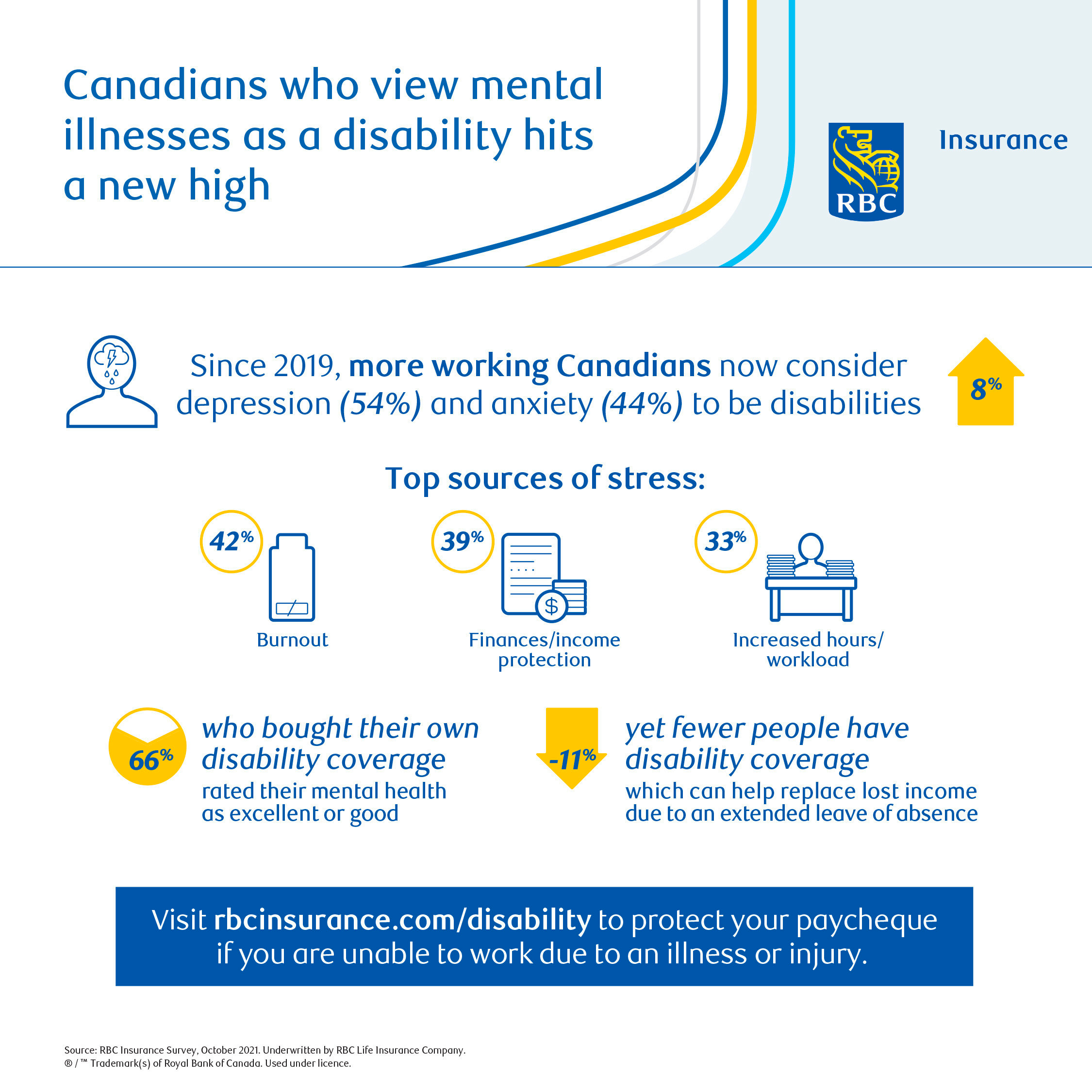
An infographic showing mental illness in Canada
RBC Insurance: More Canadians now consider depression and anxiety to be disabilities. (CNW Group/RBC Insurance)

However, feelings of stress or anxiety were significantly lower among those with support in place; Canadians who had a group benefits plan (60 per cent) and bought their own disability coverage (66 per cent) were more likely to rate their mental health as excellent or good. Still, those who rated their mental health as excellent or good in 2021 has dropped (-8 points) from the previous year. At the same time, fewer people report having disability coverage either through their workplace benefits (-6 points) or an individual disability plan (-9 points) – something which can help replace lost income should someone be unable to work for an extended period.

“The number of Canadians with disability coverage has declined from the peak of the pandemic to today,” adds Winslow. “But as mental health challenges continue to rise and the future remains uncertain, it’s more important than ever for all Canadians to consider their options for financial protection.”

Tips to manage stress and mental health

Canadians should consider these three tips to help manage stress and maintain good mental health:

  • Focus on healthy habits. Whether working at home, the office or a hybrid of both, it’s important to maintain healthy habits. Take frequent mini-breaks to exercise or meditate, and foster social connection with others. Establish clear boundaries between work and personal time. Along with a balanced diet and getting enough sleep, these are critical for supporting mental health and overall well-being.
  • Adjust your lifestyle and spending. With inflation on the rise, most people need to step up how much they save and prioritize what’s important to keep financial stress at bay. Cook at home to limit takeout meals, avoid impulse purchases, and look for areas where you can reduce or eliminate fees and services that you don’t absolutely need or use.
  • Ensure you’re covered before an injury or illness occurs. Being proactive and taking control helps to lower anxiety and provide a greater sense of safety. Disability insurance can not only ensure income protection should you become unable to work, but many plans can also help you return to work through benefits such as rehabilitation, job retraining and other services.

To learn more, visit silver.rbcinsurance.com/disability.

About the RBC Insurance Survey

These are some of the findings of an Ipsos poll conducted between October 14 to 18, 2021. For this survey, a sample of 1,501 employed Canadians aged 18+ was interviewed. Weighting was then employed to balance demographics to ensure that the sample’s composition reflects that of the population according to Census data and to provide results intended to approximate the sample universe. The precision of Ipsos online polls is measured using a credibility interval. In this case, the poll is accurate to within ±3.1 percentage points, 19 times out of 20. The credibility interval will be wider among subsets of the population. All sample surveys and polls may be subject to other sources of error, including, but not limited to coverage error, and measurement error.

About RBC Insurance

RBC Insurance® offers a wide range of life, health, home, auto, travel, wealth and reinsurance advice and solutions, as well as creditor and business insurance services to individual, business and group clients. RBC Insurance is the brand name for the insurance operating entities of Royal Bank of Canada, one of North America’s leading diversified financial services companies. RBC Insurance is among the largest Canadian bank-owned insurance organizations, with approximately 2,500 employees who serve more than four million clients globally. For more information, please visit silver.rbcinsurance.com.

Media contact

Kiara Famularo, RBC Corporate Communications, 647-272-4077

Home > Advice & Learning > Page 16

Investing With a Purpose: Understanding Socially Responsible Investing

4 Min Read
Diane Amato
Couple and their child sitting and smiling in a park

Socially Responsible Investing (SRI) has boomed in recent years as investors have discovered they can put their money behind investments that contribute to important social and environmental issues. According to SIMFUND Canada, Canadians invested more than $3.2 billion in Canadian-based environmental, social and governance (ESG) funds in 2020, while total net assets in these funds exceeded $22 billion – a 37% increase over the year before.

At the same time, studies have found that companies in SRI funds have better environmental, social and governance practices that may make them more sustainable long-term and therefore healthier and less volatile financially. A company’s ethical practices have also been shown to reduce exposure to scandals, disasters and lawsuits.

All of these factors can positively affect share prices and impact returns for investors.

Understanding SRI

When it comes to responsible investing, there are a number of terms and acronyms investors may come across – such as Impact Investing, ESG and SRI, which are sometimes used interchangeably. Understanding the difference between them can help new investors navigate this landscape.

For example, a company may be considered a responsible investment if it has a diverse board of directors – a company that manufactures weapons, on the other hand, would not be. ESG investing, meanwhile, considers how Environmental, Social and Governance factors affect the performance of a company, both positively and negatively (and therefore an investor’s returns).

Impact investing is a way to invest your money to create measurable positive outcomes. While SRI and impact investing both aim to bring about social change while delivering a financial return, impact investing requires that the change be more timely and impactful. Impact investing often involves private funds from institutional investors, while SRI investing involves investments available to all retail investors.

There’s more than one way to be a socially responsible investor

SRI investments aren’t simply selected by typical performance metrics such as earnings, growth and profit margins, but also by whether a company’s business practices align to the investor’s values – or not. To determine which companies to select for a fund, a fund manager has two methods to use: positive and negative screening.

Positive screening is a process that identifies companies making positive social or environmental contributions. Those with better ESG practices compared to their competitors are more likely to be included in the fund. While in many cases positive screening techniques highlight organizations that are actively furthering environmentally sustainable or positive social practices, positive screening is not limited to investing in companies within environmentally or socially focused industries. Companies with a stronger commitment to ESG practices in any industry may be considered as socially responsible investments.

Negative screening is one of the most basic methods of separating socially responsible investments from those that are likely to have a negative effect on society. It is one of the most widely used processes of weeding out companies that do not align with an investor’s values, such as those in industries like alcohol, tobacco or gambling, organizations associated with human rights violations or environmental damage or companies that do not meet diversity standards.

Both methods can lead to socially responsible investing. While negative screening prevents investors from supporting practices they find undesirable, positive screening purposefully supports those companies that are actively doing good and supporting investor values.

Investing in line with your values can pay off

For Canadians looking to invest in funds that can make a positive difference in the world, the future is bright. New funds continue to be introduced as interest grows in SRI investing. Companies with strong ethical and environmental practices may perform better in the long-term because they’re more sustainable. With a win-win situation like this, it’s no wonder Canadians are increasingly adopting socially responsible investment practices.

Interested in investing in an SRI fund? Speak with your RBC Insurance Advisor and learn about the new funds we’re introducing to support your goals and values.

Call us at 1-888-512-3059.


RBC Insurance

We make it easy to find expert advice, money-saving tips, and a range of insurance options for every moment of life.

*Home and auto insurance products are distributed by RBC Insurance Agency Ltd. and underwritten by Aviva General Insurance Company. In Quebec, RBC Insurance Agency Ltd. Is registered as a damage insurance agency. As a result of government-run auto insurance plans, auto insurance is not available through RBC Insurance in Manitoba, Saskatchewan and British Columbia.

This article is intended as general information only and is not to be relied upon as constituting legal, financial or other professional advice. A professional advisor should be consulted regarding your specific situation. Information presented is believed to be factual and up-to-date but we do not guarantee its accuracy and it should not be regarded as a complete analysis of the subjects discussed. All expressions of opinion reflect the judgment of the authors as of the date of publication and are subject to change. No endorsement of any third parties or their advice, opinions, information, products or services is expressly given or implied by Royal Bank of Canada or any of its affiliates.

Home > Advice & Learning > Page 16

What are Segregated Funds, and How Can they Complement an RRSP Portfolio?

3 Min Read
RBC Insurance
Woman drinking coffee while checking her RRSP portfolio on a computer

But when thinking about the type of funds to choose, keep in mind that as you approach retirement, your financial needs, goals, and how you invest will start to change.

While retirement may still be in the distant future, eventually you’ll need to protect the money you’ve worked hard to save, while still making it grow in order to carry you through retirement. In fact, according to an RBC Insurance survey, 87 per cent of Canadians aged 55 and over agree that they’d like an investment product that guarantees the money they invest, but that also offers opportunities for growth. Yet 60 per cent are not aware that this option is available with segregated (seg) funds.1

Growth and Guarantees for Your Investments

Segregated funds are an investment solution only available through insurance companies. They help to grow and protect your hard earned savings with the added security of principal guarantees. Think of it as a combination of a mutual fund and an insurance policy. In other words, money is invested in professionally managed and diversified assets with the growth potential similar to mutual funds. But segregated funds have additional insurance components that protect the original amount invested.

Segregated funds offer several other unique benefits that other investment products don’t have, including:

  • Protection through guarantees.2 A maturity guarantee helps to protect your initial investment (at contract maturity), while a death benefit guarantee ensures that your named beneficiaries will receive 75% or 100% of the amount that was invested (depending on the guarantee option chosen by you) on your death.
  • Reduce estate-planning costs. After a person dies, there is a legal approval process required to validate their Will. This process is called probate, and can be a lengthy administrative hassle that incurs fees. As an insurance product, segregated funds death benefits paid to specific beneficiaries are not subject to the probate process, meaning that funds go directly to the beneficiary, without any estate or probate fees3.
  • Potential protection from creditors. Segregated funds are considered an insurance contract so they may be exempt from seizure by creditors if the named beneficiaries are in the protected class under provincial law. This may be an important benefit for professionals, entrepreneurs and business owners who might be involved in an unexpected lawsuit or bankruptcy.
  • Increase your protected amount. If your investment has earned money, you may have the option to “reset” the guaranteed value of your investment, which locks in the gains you’ve earned.

These guarantees and benefits, combined with the growth potential, are what make segregated funds so appealing to those who are planning or approaching retirement.

Interested in Learning More About Segregated Funds?

Segregated funds can only be purchased through a life insurance advisor. Have an RBC Insurance advisor contact you to learn more.

1) https://www.rbc.com/newsroom/news/article.html?article=123680
2) Guarantees are proportionally reduced by withdrawals.
3) Probate fees and requirements vary by province.


RBC Retirement Investment Solutions

Whether you’re building up your nest egg or ready to turn your hard-earned savings into retirement income, our solutions can help you make the most of your money. Have an RBC Insurance Advisor call you to learn more.

This article is intended as general information only and is not to be relied upon as constituting legal, financial or other professional advice. A professional advisor should be consulted regarding your specific situation. Information presented is believed to be factual and up-to-date but we do not guarantee its accuracy and it should not be regarded as a complete analysis of the subjects discussed. All expressions of opinion reflect the judgment of the authors as of the date of publication and are subject to change. No endorsement of any third parties or their advice, opinions, information, products or services is expressly given or implied by Royal Bank of Canada or any of its affiliates.

Any amount that is allocated to a segregated fund is invested at the risk of the contract holder and may increase or decrease in value. RBC Guaranteed Investment Funds are individual variable annuity contracts and are referred to as segregated funds. RBC Life Insurance Company is the sole issuer and guarantor of the guarantee provisions contained in these contracts. The underlying mutual funds and portfolios available in these contracts are managed by RBC Global Asset Management Inc. When clients deposit money in an RBC Guaranteed Investment Funds contract, they are not buying units of the mutual fund or portfolio managed by RBC Global Asset Management Inc. and therefore do not possess any of the rights and privileges of the unitholders of such funds. Details of the applicable Contract are contained in the RBC GIF Information Folder and Contract at silver.rbcinsurance.com/gif.

Home > Advice & Learning > Page 16

RBC Health Insurance helps protect your paycheque until you can get back to work

5 Min Read
Alexandra Macqueen
Woman on her phone, thinking about health insurance options

Nearly seven in 10 Canadians report that they have current debt – and four in 10 say they don’t know how they would pay their bills if they became critically ill or disabled and couldn’t work.

One option to help keep income flowing if an unexpected sickness or injury happens is through an insurance policy. While critical illness and disability insurance are different products, they serve a similar purpose of protecting your finances should you become unable to work and earn an income.

The lowdown on disability insurance

Disability insurance pays a monthly income, this is called the benefit, that replaces a portion of your regular pay cheque if you suddenly find yourself in a situation where you can’t work because you’re sick or injured. This includes mental illnesses such as anxiety, depression and post-traumatic stress disorder. Here are a few examples of an illness or injury, that might qualify for benefits under a disability insurance policy:

  • if you develop a mental illness, such as generalized anxiety disorder;
  • if you are injured, such as if you break your leg; or
  • if you develop a physical illness, such as multiple sclerosis.

Your specific disability insurance policy will explain the details of your coverage – such as:

  • how long you would need to be disabled before monthly payments begin,
  • the maximum amount of money you could receive each month, and
  • how long the payments might last if you continue to be disabled.

For example, your policy might say that payments would cover 60 percent of your gross salary to a maximum of $4,500 per month; it would start 60 days after you develop a condition that is covered under your policy (that 60 days is referred to as the “waiting period”), and payments will last until you’re age 65, so long as you continue to be disabled and unable to work.

Disability insurance plans will either cover you for your “own occupation” or “any occupation.” If you have “own occupation” coverage, you will continue to receive your monthly benefit if you are unable to return to your regular, pre-disability job. In contrast, if you have “any occupation” coverage and you are unable to return to your regular job but could take a less-demanding job, your benefit payments could stop.

Some Canadians may have disability insurance through work. A workplace policy is more likely to provide “any occupation” coverage, so be sure to ask your HR department what kind of coverage you have, if any.

Canadians can purchase an individual disability policy from an insurance broker or insurance company, and can select coverage that is catered to their own needs, including purchasing a policy with “own occupation” coverage.

The number of Canadians who have disability insurance through work is declining – fewer than half of Canadian employees say they have coverage through work, and out of those employees with no work coverage, more than eight in 10 say they have not purchased their own personal policy.

If you have workplace coverage, and your employer pays the cost of the insurance on your behalf, the income you’d get from the policy is taxable. If you pay the cost of your disability insurance from work yourself, the monthly benefit is not taxable.

If you have a personally owned policy, the monthly income you receive if you become ill or disabled is not taxable.

The lowdown on critical illness insurance

A critical illness policy will pay out a lump sum if you are diagnosed with one of the illnesses covered by the policy – such as cancer, Alzheimer’s disease, a heart attack or a stroke.

Unlike a disability insurance policy, critical illness provides coverage for certain illness but no injuries.

The lump sum benefit from a critical illness policy is not determined by your income prior to diagnosis, and unlike disability insurance, you don’t have to have a job to qualify.

Another difference you may have noticed between disability insurance and critical illness is that you receive one lump sum payment with critical illness, instead of the monthly payments you would receive with disability insurance.

The lump sum payment is tax-free. You receive the payment after a relatively short wait time – called the survival period, this is usually 30 days after your diagnosis – and your claim is approved by the insurance company.

Receiving a critical illness benefit doesn’t affect any disability payments you may also be receiving or are eligible for, and there are no restrictions on how you spend the money. For example, you might decide to use the lump sum payment to help with housekeeping chores you are no longer able to carry out personally, to pay for the cost of child care, or to retrofit your home to better suit your needs.

If you’re interested in critical illness insurance, you will need to carefully review and compare policies and ask lots of questions – as the coverage can vary significantly. For example, some policies may only provide a payout if you are diagnosed with one of five conditions, while others might cover as many as 30 different conditions.

While many Canadians are aware of the importance of life insurance, critical illness and disability insurance can be an equally important part of your financial plan. Critical illness and disability insurance are sometimes referred to as “living benefits” because unlike life insurance, you could receive payments from this policy while you are still alive; so it offers protection to you directly, as opposed to your beneficiary.

Have you put together a plan for how you would pay your bills or manage expenses if you suddenly become ill or injured and can’t work? Consider taking some time to calculate how much you might need should the unexpected happen, to make sure that your income is protected, and to learn what options are out there to help.


RBC Disability Insurance

Help ensure your expenses are covered if you get sick or injured

Learn More

*Home and auto insurance products are distributed by RBC Insurance Agency Ltd. and underwritten by Aviva General Insurance Company. In Quebec, RBC Insurance Agency Ltd. Is registered as a damage insurance agency. As a result of government-run auto insurance plans, auto insurance is not available through RBC Insurance in Manitoba, Saskatchewan and British Columbia.

This article is intended as general information only and is not to be relied upon as constituting legal, financial or other professional advice. A professional advisor should be consulted regarding your specific situation. Information presented is believed to be factual and up-to-date but we do not guarantee its accuracy and it should not be regarded as a complete analysis of the subjects discussed. All expressions of opinion reflect the judgment of the authors as of the date of publication and are subject to change. No endorsement of any third parties or their advice, opinions, information, products or services is expressly given or implied by Royal Bank of Canada or any of its affiliates.

Home > Advice & Learning > Page 16

Seven Ways to Save Money on Car Insurance

5 Min Read
Amanda Reaume
Person using a key to unlock a car door

Personalizing your coverage and finding ways to lower your costs by working with a licensed insurance advisor can help you stay protected and keep more money in your wallet.

Short-term hacks

Did you know that you might be eligible for savings because of things you’re already doing?

Car insurance companies offer discounts to drivers who do things that help reduce their risk of getting into an accident or making other types of claims. For example, installing snow tires on your car in the winter, only driving your vehicle for low-mileage pleasure use, or having an anti-theft device may all save you money.

New Driver or Student in the House

Newly licensed drivers may be eligible for savings when they graduate from a beginner’s license class and move to another license level. Also let your insurance company know if children listed as drivers on your policy are attending school away from home. There might be some savings on your insurance premiums because they will have limited access to your car.

Are you a new driver? Check out these tips on smarter choices you can make for car insurance.

Bundling your car insurance

You can also save money on car insurance by bundling your car insurance with your home or renter’s insurance or by having multiple cars in your house insured with the same company.

Employers and associations

You might be eligible for insurance discounts as a member of a union, a professional association or other organization.

Customize your coverage

Another way to reduce the cost of car insurance is to personalize your coverage. There is mandatory coverage required such as third-party liability and accident benefits, which provide coverage if you get into an accident that causes personal or property damage. But there are other types of coverages that may be optional like collision and comprehensive coverage and emergency roadside assistance.

Make sure your plan fits your needs today. While you shouldn’t give up the coverage you need, one size does not fit all — and your needs may change over time. Is your car several years old? Its value might have gone down significantly, which could affect your need for something like collision and comprehensive coverage on your vehicle. You might also consider increasing your deductible which is the amount you pay when you make a claim. If you get insurance with a $1,000 deductible, you may pay less premiums than if you get insurance with a $500 deductible.

Overall, customizing your coverage can help you:

  • Save money by only paying for what you need
  • Protect you and your family
  • Adjust your coverage as your life changes

Longer-term strategies

Now that you’ve found some quick saving opportunities, you’re likely wondering if there are longer-term changes you can make that might help you save money on car insurance in the future. The good news is that there are.

Tickets and Accidents

Your driving record is a key factor in determining how much you pay for insurance. It includes your class of license, number of years licensed, traffic convictions, and claims.

The most important thing is to drive safely and don’t get driving violations like speeding tickets, failing to yield or distracted driving to name a few. Thankfully parking tickets don’t affect your insurance rates, but avoiding them still helps to keep money in your wallet.

So what about accidents? Unfortunately mistakes happen—it is, after all, called an “accident” for a reason. Getting accident forgiveness coverage in advance is another long-term strategy to protect you against future premium increases after your first at-fault accident. But remember: accident forgiveness coverage helps to protect your premiums from increasing only after your first at-fault accident. Any accidents you have after that will likely affect your insurance premiums.

Credit Score

Another way you could decrease your premium in certain provinces is to have a good credit rating (excluding Newfoundland, Labrador and Ontario, where credit scores are not allowed to be used for auto insurance premium calculations). The better your credit score is, the lower your insurance premiums may be should you choose to disclose it.

Vehicle Type

Get insurance quotes for the vehicles you are thinking about leasing or buying before you close the deal. The year, make and model of a vehicle may affect the cost of your insurance. Some cars have a higher likelihood of being stolen or being in more accidents, so insurance companies charge more to insure those vehicles. By checking on rates in advance, you might save a significant amount in insurance premiums over the life of your vehicle.

Be sure to check your policy every year to ensure that all the information is accurate and up to date. Ask questions in case there are discounts your insurance company offers that you qualify for. An RBC Insurance advisor can help you do that. Call 1-877-749-7224 or get a quote online today.

If you’re interested in learning more about car insurance, check out How Car Insurance Premiums are Calculated next.

Get Your Free Car Insurance Quote

Take a few minutes to get a competitive auto insurance quote online*

Learn More

*Home and auto insurance products are distributed by RBC Insurance Agency Ltd. and underwritten by Aviva General Insurance Company. In Quebec, RBC Insurance Agency Ltd. Is registered as a damage insurance agency. As a result of government-run auto insurance plans, auto insurance is not available through RBC Insurance in Manitoba, Saskatchewan and British Columbia.

This article is intended as general information only and is not to be relied upon as constituting legal, financial or other professional advice. A professional advisor should be consulted regarding your specific situation. Information presented is believed to be factual and up-to-date but we do not guarantee its accuracy and it should not be regarded as a complete analysis of the subjects discussed. All expressions of opinion reflect the judgment of the authors as of the date of publication and are subject to change. No endorsement of any third parties or their advice, opinions, information, products or services is expressly given or implied by Royal Bank of Canada or any of its affiliates.

Home > Advice & Learning > Page 16

Digital Wellness Check: How Young Canadians can Stay Connected and Healthy Online

5 Min Read
Shannon Lee Miller
Four children standing outside together looking at their phones

In the age of physical distancing, staying connected may be more important than ever before. Especially for youth. For parents, knowing when and how to check in with kids and adolescents about online safety and digital wellness isn’t always easy, but there are several ways families can work together to surf safely, stay connected and protect mental health.

69% of Canadians between ages 13-24 say the pandemic has had a negative or very negative impact on their mental health, according to a 2020 poll conducted by One Youth and UNICEF.1

86% are concerned about maintaining relationships with friends and loved ones.

The internet can offer young people places to learn, play and interact with friends; but for youth, it can also raise issues about body image, self-harm, cyberbullying and poor sleep. It’s important to note that screen time may have mental health drawbacks of its own.

Write some code

Coming up with a code of clear expectations for online activity may be helpful for both parents and kids navigating a new, virtual reality. For younger children, rules could be as simple as “No devices at dinner” or “Parental supervision required.” For older kids and teens on social media, parents may want to put limits in place to protect personal information, passwords and photos.

P.S. Boundaries can be good for everyone. When your 12-year-old begs you to take down that silly video of her first dance recital, it might be time to listen. Looking for ideas for your family’s online safety rules? The Canadian Safety Council has examples to help you.

Know the signs of cyberbullying

Chat features on games and social media can help kids find friends—and sometimes, bullies. One-fifth of bullying now occurs through social media, according to data collected between 2018-2020.2

If your child becomes secretive about their internet activity, deletes accounts or avoids using once-beloved devices altogether, there could be something happening online. Letting your child know they can talk to you—judgment-free—about their social (media) life could be a great way to start.

Develop a digital dialogue

Socializing on a screen isn’t quite the same as hanging out with old friends at school. Familiarizing yourself with the games, services and apps your child is enjoying can clue you in on what media they’re consuming, which privacy controls are in place and how they communicate. Keep tabs on where and with whom your child is spending time online. Ask questions. Show an interest. Learn the lingo. It may even help you bond. A mom might score major points for knowing the difference between a Creeper and a Cave Spider in Minecraft.

Put devices to bed early

Turning out the (blue) light before bed to listen to some relaxing music, read a book, or a guided meditation might be a better way than gaming to wind down. If your kiddo is too cool for ocean sounds and yoga, consider a pair of blue-light-blocking glasses or an app to keep that circadian rhythm on the beat.

Why? Playing just one more round of “Candy Crush” before lights out might be fun for kids (and grownups), but it could impact the duration and quality of sleep.3

Get in some real face time

With school, work and social lives largely relegated to screens, young people (and parents!) may benefit from a little face-to-face interaction. After living the quarantine life, you and your child might feel like you’ve had enough time together, but sitting down for a family meal, grabbing a cup of coffee, engaging in some endorphin-boosting athletics or walking the family dog can be great ways to get intentional about unplugging and checking in with each other.

Make help available

Growing up isn’t always easy. During a pandemic, children and adolescents may face a unique set of challenges. Notice any sudden changes in mood or behavior, appetite or sleep? It may be time to talk with your child about professional support. Arming them with a list of youth-friendly resources, such as these from RBC Future Launch, may remind them that help is out there if they need it.

In Canada, nearly 100 percent of youth aged 15 to 24 use the internet or their smartphone daily, according to a 2019 report from Statistics Canada. With so much of life being lived online, it may be more important now than ever for children and parents to stay connected, talk about digital wellness and prioritize mental health.

Warning signs that you should seek professional psychological help

According to the Mental Health Commission of Canada, “Unlike other health conditions, only one in three people who experience a mental health problem or illness report that they have sought and received services and treatment.”

According to MentalHealth.gov, pay attention if you experience:

  • Sleeping too little or too much
  • Withdrawing from your usual social outlets or relationships
  • Feeling listless, numb, helpless or hopeless
  • An increase in smoking, drinking or taking drugs
  • Mood swings, irritability or uncontrolled anger
  • Anxiety or depression
  • Urges to self-harm
  • Inability to perform daily tasks

Sources:
1. Impacts of the COVID-19 Pandemic on Young People in Canada. U-REPORT CANADA. Unicef Canada and One Youth. May 2020.
2. Cyberbullying facts and statistics for 2020. Comparitech Limited. November 11, 2020.
3. Blue light has a dark side. Harvard Health Publishing, Harvard Medical School. July 7, 2020.

RBC Disability Insurance

Help ensure your expenses are covered if you get sick or injured

Learn More

*Home and auto insurance products are distributed by RBC Insurance Agency Ltd. and underwritten by Aviva General Insurance Company. In Quebec, RBC Insurance Agency Ltd. Is registered as a damage insurance agency. As a result of government-run auto insurance plans, auto insurance is not available through RBC Insurance in Manitoba, Saskatchewan and British Columbia.

This article is intended as general information only and is not to be relied upon as constituting legal, financial or other professional advice. A professional advisor should be consulted regarding your specific situation. Information presented is believed to be factual and up-to-date but we do not guarantee its accuracy and it should not be regarded as a complete analysis of the subjects discussed. All expressions of opinion reflect the judgment of the authors as of the date of publication and are subject to change. No endorsement of any third parties or their advice, opinions, information, products or services is expressly given or implied by Royal Bank of Canada or any of its affiliates.

Home > Advice & Learning > Page 16

Four Ways to Practice Mental Health Hygiene

6 Min Read
Beth Levine
A woman who practices mental health hygiene

Everybody knows about the importance of physical hygiene—wash your hands, brush your teeth, shower often, comb your hair, and so on. But not much discussion is given to mental health hygiene: the knowledge and skills required to maintain mental well-being. According to the Mental Health Commission of Canada, mental health is:

A state of well-being in which the individual realizes his or her own potential, can cope with the normal stresses of life, can work productively and fruitfully, and is able to make a contribution to her or his own community.

Mental self-care is important

If you want to live your best life, you need to tend to your emotional, psychological and social well-being. “In order to meet the demands of life, you need to be able to use your brain to the best of your capacity in the present moment. This will allow you to make good decisions and respond appropriately to stressors, instead of reacting with your fight-or-flight response,” says Marie Claire Bourque, MD, psychiatrist and clinical assistant professor, University of Calgary.

Be proactive about your mental health

According to the Canadian Community Health Survey, one-third of the Canadian population (approximately 9.1 million people) will be affected by a mental illness at some point during their lives. Don’t wait until you have symptoms before taking the first step. Experts recommend four practices to help protect your mental well-being.

1. Practice mindfulness

Studies show that the practice of mindfulness can be effective in reducing anxiety, depression and stress. Mindfulness is a kind of meditation whereby you become completely present—not focused on the past or the future. “Mindfulness is a state of being. You can be mindful when cooking, walking, brushing your teeth. It is, very simply, a state of complete awareness of the present moment without judgment,” says Dr. Bourque.

Mindfulness tips from the professionals:

  • Take a moment to stop and notice with all five senses what is going on around you.
  • Close your eyes and focus on your breath. If thoughts come, simply notice, and then bring your awareness back to the breath.
  • Sit or lie comfortably and mentally scan your body. Focus on what each part is feeling. If one part feels tense, relax the muscle.
  • Walk outside in nature and tune into the sights, sounds and smells.
2. Exercise

If you want to ward off the blues or reduce stress and anxiety, exercise should be at the top of your list. One study in the International Journal of Psychiatry showed that exercise “compares favorably to antidepressant medications as a first-line treatment for mild to moderate depression and has also been shown to improve depressive symptoms when used as an adjunct to medications.”

Why? Anxiety Canada points out that getting your heart pumping releases those feel-good endorphins, boosts your self-confidence, promotes being social, lowers stress, helps you sleep better and improves your physical health.

You don’t have to be a fitness expert to reap the exercise rewards. Try these, say the experts:

  • Exercise doesn’t have to be 30 consecutive minutes. You can take five or 10- minute breaks throughout the day to get your heart rate up.
  • Dance, go for a walk or bike ride, or practice yoga to a video or a Zoom class.
  • Get creative. Walk around while talking on the phone. Take the stairs instead of the elevator. Bike to run errands. Toss a frisbee with your dog.
3. Express gratitude

“When you express gratitude, your brain rewards you by releasing feel -good neurotransmitters dopamine, and serotonin, and a little of the hormone oxytocin,” says Dr. Bourque.

How can you do this?

  • Journal daily about all the things in your life you appreciate.
  • Create a family dinner ritual in which each member expresses one thing they are grateful for.
  • Express thanks to other people. For example, if you see a waitress or postal worker who is running ragged, say, “Thanks for working so hard.”
  • If you meditate, end every session by thinking of what you are grateful for and sit with that for a few minutes.
  • Post the word “gratitude” somewhere in your house or office; whenever you see it, take a moment to think about it.
4. Sleep well

This may be the most critical part of all, says Dr. Bourque. Your brain cannot function properly without adequate sleep. Just as your body needs to rest after physical exertion, your brain needs sleep to recover and process the day’s events. Need more convincing? Recommendations from sleep hygiene experts:

  • Don’t fall for the hype. There is a tendency these days for people to brag about how little they sleep, to prove how hard they work. The thing is, according to the National Sleep Foundation (NSF), getting adequate sleep makes you more productive, not less. It may prevent burnout, help you recover faster from distractions, enable you to make better decisions, and bolster your memory.
  • Avoid caffeine and alcohol in the hours before bedtime. The NSF notes that it takes six hours for your body to process half the caffeine you took in. And contrary to general perception, alcohol may actually disrupt sleep.
  • Turn off your screens close to bedtime. The bright lights interrupt your natural circadian rhythm by signaling to your body that it’s time to be awake.
  • Create a bedtime routine and stick to it.
  • Bedtime is an excellent time to practice your mindfulness techniques.
  • If you have severe sleep issues, see a sleep medicine physician.

Disclaimer: Experts caution not to begin a new exercise regimen without first consulting your doctor or a health professional; this piece represents general advice.

Warning signs that you should seek professional psychological help

According to the Mental Health Commission of Canada, “Unlike other health conditions, only one in three people who experience a mental health problem or illness report that they have sought and received services and treatment.”

According to MentalHealth.gov, pay attention if you experience:

  • Sleeping too little or too much
  • Withdrawing from your usual social outlets or relationships
  • Feeling listless, numb, helpless or hopeless
  • An increase in smoking, drinking or taking drugs
  • Mood swings, irritability or uncontrolled anger
  • Anxiety or depression
  • Urges to self-harm
  • Inability to perform daily tasks

RBC Disability Insurance

Help ensure your expenses are covered if you get sick or injured

Learn More

*Home and auto insurance products are distributed by RBC Insurance Agency Ltd. and underwritten by Aviva General Insurance Company. In Quebec, RBC Insurance Agency Ltd. Is registered as a damage insurance agency. As a result of government-run auto insurance plans, auto insurance is not available through RBC Insurance in Manitoba, Saskatchewan and British Columbia.

This article is intended as general information only and is not to be relied upon as constituting legal, financial or other professional advice. A professional advisor should be consulted regarding your specific situation. Information presented is believed to be factual and up-to-date but we do not guarantee its accuracy and it should not be regarded as a complete analysis of the subjects discussed. All expressions of opinion reflect the judgment of the authors as of the date of publication and are subject to change. No endorsement of any third parties or their advice, opinions, information, products or services is expressly given or implied by Royal Bank of Canada or any of its affiliates.